How do you change a subscription price in App Store Connect?
To change a subscription price, schedule a new price per country or region and choose whether existing subscribers keep the old one. Decreases reach existing subscribers automatically. Increases need consent when they exceed 50% and about $5 a period, repeat within 12 months, or fall in a region requiring consent.
Changing an auto-renewable subscription price is a scheduling task with consequences for every current subscriber. App Store Connect applies one future price per country or region, notifies or asks subscribers depending on the size of the change, and treats a decrease as permanent once it takes effect. Each decision below should be made before the price is saved.
What happens to existing subscribers when you raise a price?
When you raise an auto-renewable subscription price, you either apply the new price to existing subscribers or preserve their current price. Preserved subscribers keep paying the old price, and one whose subscription lapses can resubscribe at that preserved price within 60 days of expiration.
Apple’s pricing guide sets the notice periods: subscribers hear about an increase at least 27 days before renewal on a monthly plan and 30 days on longer ones, and on plans of two months or more the first consent requests start 60 days out. An increase scheduled inside the minimum window renews once more at the old price. Subscribers on a free trial or introductory offer also renew at least once at the price they signed up for.When do subscribers have to consent to an increase?
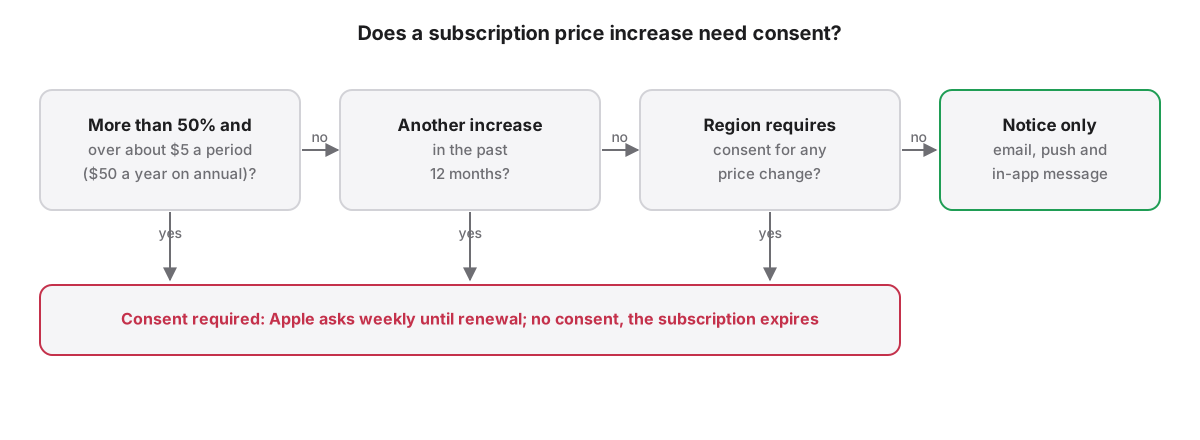
Subscribers must consent to a price increase when it exceeds 50% of the current price and adds more than about US$5 per period, or US$50 a year on annual plans, when they already had an increase in the past 12 months, or when their country or region requires consent for any change.
Thresholds per storefront are in Apple’s price increase thresholds. Apple asks for consent roughly weekly by email, push notification and in-app message. A subscriber who never agrees is not charged the new price: the subscription simply expires at the end of the current billing period, which is the real cost of a large increase.
What happens when you lower a subscription price?
A lower auto-renewable subscription price reaches existing subscribers automatically: they renew at the lower price with no action. Apple notes that a decrease cannot be reversed once it takes effect, although a later increase can be scheduled, with that increase subject to the consent rules again.
This makes a purchasing-power discount more expensive than it looks. Lowering India or Brazil to win new subscribers also lowers the price for everyone already paying in those countries. Model the lost revenue from the current base before cutting.
How many subscription price changes can you schedule?
App Store Connect allows one scheduled future price change per country or region per billing plan type. Scheduling a second change overwrites the first, and the earliest possible start is usually one to two days ahead, because App Store Connect works out the date across time zones.
Through the API the same limits show up as errors. A change to an approved subscription must start no earlier than tomorrow in UTC, and a territory with a pending price refuses another until the pending row is deleted. Preserved prices come back as undated rows that look like current prices; reading them as the live price reports a number new subscribers never see.
Why don't subscription prices follow exchange rates?
Apple does not adjust auto-renewable subscription prices for tax or exchange rate movements; its retail price updates exclude subscriptions. Each storefront keeps the price you set until you change it, so a subscription priced years ago in a weakening currency can drift far from your US price.
Unlike app and in-app purchase prices, subscription prices are stored as separate rows per territory and never equalize from a base price on their own. Reviewing them yearly against the US price, or against a purchasing-power rule, catches the drift. See why App Store prices revert in some countries for the non-subscription side.
App Store Localization for Mac reads and plans every change for free; a one-time license applies them. macOS 26 or later.
Key takeaways
- Decide before saving whether existing subscribers keep their price or move to the new one.
- Increases above 50% and about $5 a period, or a second within 12 months, need consent.
- A subscriber who never consents loses the subscription at the end of the billing period.
- Decreases reach existing subscribers automatically and cannot be reversed once in effect.
- Only one future price per territory and plan type; a second schedule overwrites the first.
Frequently asked questions
Do existing subscribers pay a new higher subscription price?
Only if you choose to apply it to them. App Store Connect lets you preserve the current price for existing subscribers, in which case only new subscribers pay more. If you apply it, Apple notifies subscribers or asks for their consent, depending on the size of the increase and their region.
How far ahead must a subscription price change be scheduled?
App Store Connect usually sets the earliest start one to two days ahead, based on time zones. Subscribers then need notice before renewal: 7 days on weekly plans, 27 days on monthly plans and 30 days on longer ones, so an increase inside that window renews once more at the old price.
Can I undo a subscription price decrease?
Not once it has taken effect. Apple states that a decrease cannot be reversed after it goes into effect, though you can schedule a later increase. That increase then follows the normal notice and consent rules, so test discounts on new subscribers before lowering the price for everyone.