How do App Store price points work for in-app purchases?
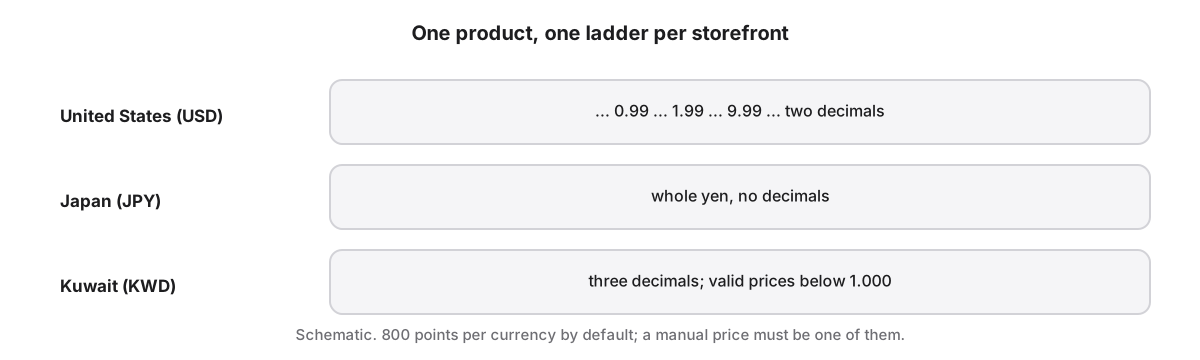
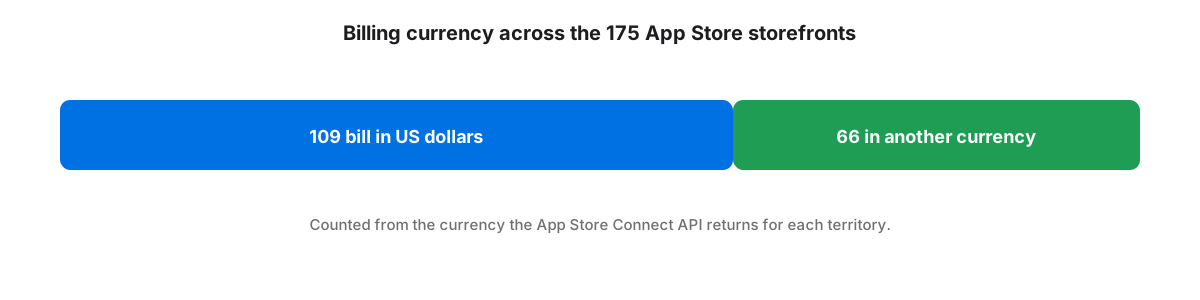
Every App Store price must be one of Apple's price points, a ladder of 800 prices per currency by default. You pick a base country and price; Apple equalizes it across the other storefronts, and you can override any of them with a point from that storefront's own ladder. Of 175 storefronts, 109 bill in US dollars.
App Store price points replaced the old numbered tiers. Each storefront has its own ladder of allowed prices, and every app, in-app purchase or subscription price is one point on it. Understanding the ladder explains why some prices cannot be set exactly, why some countries show dollar prices, and why a few valid prices sit below one.
What is an App Store price point?
An App Store price point is one of a fixed set of prices Apple allows in a storefront's currency. Apple documents up to 800 price points in each currency for auto-renewable subscriptions. A manual price must match a point exactly, so a target such as 3.37 snaps to the nearest point.
Apple describes the ranges in pricing and availability for in-app purchases. When you set a price in a base country, Apple fills the other storefronts with its equalized price for that point, adjusted for taxes and exchange rates. Any storefront can then get a manual price from its own ladder instead.
How do price point IDs work in the API?
In the App Store Connect API, each price point has an opaque ID. In our tests the ID decodes as base64 JSON naming the product, the territory and the point, so a ladder fetched for one product can be reused for another product of the same kind by changing the product part.
Ladders are large: roughly 800 points across 175 territories for every product type. App Store Localization for Mac fetches each ladder once per product kind and territory and caches it for 30 days, and its planner refuses to proceed unless at least 90% of the territories return a nonempty ladder. Relying on the ID format is an implementation detail Apple does not document, so a tool should fall back to fetching.
Why do some storefronts bill in US dollars?
Apple bills 109 of the 175 App Store storefronts in US dollars, based on the currency field the App Store Connect API returns for each territory. A customer in one of those storefronts sees a dollar price, so a purchasing-power price for that country has to be converted into dollars.
The territory list is available from the territories endpoint. A tool that converts targets into the local currency instead of the billing currency picks the wrong point on the ladder for every one of those 109 storefronts.
Why are some valid App Store prices below one?
Some currencies have high unit values, so their App Store price points start well below one. Kuwait and Bahrain bill in dinars with three decimals, and prices under 1.000 dinar are ordinary points on their ladders. A filter that discards prices below one as mistakes drops real prices.
The original App Store Localization server had exactly this bug: a filter meant to skip tiny prices removed valid dinar prices. The fix is to compare the price's US dollar equivalent against a threshold, never the raw number.
Does Apple change your prices when exchange rates move?
Apple periodically updates App Store prices for apps and in-app purchases when taxes or exchange rates change, starting from your base price. It does not apply those updates to auto-renewable subscriptions, whose prices stay as set until you change them yourself.
A manual price you set in a storefront stays manual; only automatically equalized storefronts follow Apple's updates. For subscriptions, see how to change a subscription price in App Store Connect.
App Store Localization for Mac reads and plans every change for free; a one-time license applies them. macOS 26 or later.
Key takeaways
- Every App Store price is a point on a per-currency ladder, 800 points by default plus 100 higher ones on request.
- A base price is equalized across storefronts; any storefront can take a manual point instead.
- 109 of 175 storefronts bill in US dollars, so convert targets into the billing currency.
- Dinar prices below 1.000 are valid; filter tiny prices by their dollar value, not the raw number.
- Apple's tax and exchange rate updates apply to apps and in-app purchases, never to auto-renewable subscriptions.
Frequently asked questions
How many price points does the App Store have?
Apple documents up to 800 price points in each currency for auto-renewable subscriptions, and apps and in-app purchases use similar per-currency ladders. Every storefront has its own ladder, so the exact numbers differ by currency, and a manual price must match one of that storefront's points.
Can I set any price I want on the App Store?
No. A price must be one of Apple's price points for that storefront's currency. A target like 3.37 has to snap to the nearest available point. With hundreds of points per currency the nearest one is usually close, but round psychological prices may not exist in every currency.
Why does my app show a dollar price in some countries?
Apple bills many storefronts in US dollars rather than the local currency: 109 of the 175, by the currency the App Store Connect API reports per territory. Customers there see and pay a dollar price, so set and check prices for those storefronts in dollars.