App Store Localization web app vs Mac app: what changed?
App Store Localization is now a Mac app instead of a hosted web app. Your App Store Connect API key stays in your Mac's Keychain, translation runs on your own Claude Code login or API key, and every write shows old and new values first. The download is free for reading and planning; applying changes costs $79 once.
App Store Localization moved from a PHP web app to a native macOS app on 2026-10-29. The rewrite kept the two jobs the web app did, translating App Store listings and setting purchasing-power prices, and added releases, in-app products, review replies, a sales view, the 51-command asl CLI and an MCP server. Accounts already signed in to the web app can keep using it until it is retired.
What is different between the web app and Mac app?
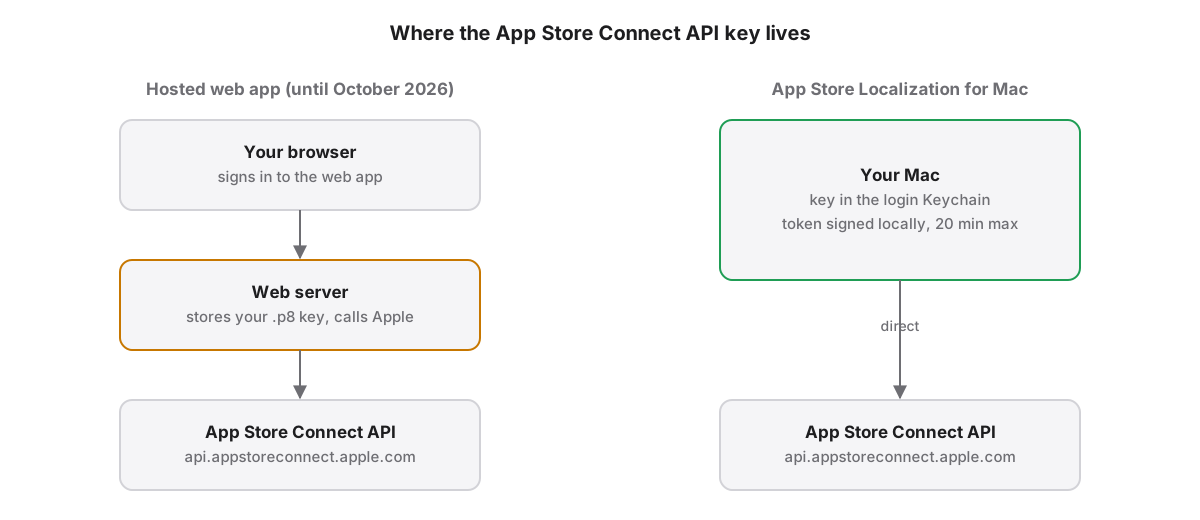
The App Store Localization web app stored each customer's App Store Connect API key on a server, ran every call from there, and charged per action. The Mac app keeps the key in the macOS login Keychain, calls Apple directly, covers releases, products, reviews and sales, and costs one $79 license.
The table compares the two versions on the points that change how you work.
| Aspect | Hosted web app (to October 2026) | App Store Localization for Mac |
|---|---|---|
| Where it runs | A PHP server at appstorelocalization.com | Your Mac, macOS 26 or later |
| API key storage | On the server | Your login Keychain |
| Calls to Apple | From the server | From your Mac, straight to Apple |
| Translation model | Run by the server | Your Claude Code login, or your Anthropic or OpenAI key |
| Pricing rule | PPP without a rich-market gate or floor | PPP with a 0.60 gate, a 25% floor and Apple's price as anchor |
| Releases and submission | Not available | Preflight, version, build attach, screenshots, submit |
| Products and reviews | Not available | IAPs, subscriptions, offer codes, review replies |
| Automation | Not available | 51 CLI commands and a 16-tool MCP server |
| Price | $1 to $10 per action | Free to read and plan, $79 once to apply |
The per-action prices came from the web app's own price list: $1 for a smart update or a single locale, $5 for a forced retranslation, and $10 for all locales or a purchasing-power update. The Mac app replaces those per-action charges with a one-time license.
Why does the API key now stay on the Mac?
An App Store Connect API key with the App Manager or Admin role can change prices, submit builds and edit every listing in a developer account. The Mac app keeps that key in the macOS login Keychain, signs each request locally, and sends it straight to Apple, so no third-party server ever holds the key.
Apple's API authenticates with a JSON Web Token signed by your .p8 private key, and Apple limits ordinary tokens to 20 minutes, with longer exceptions only for some read-only scopes. The Mac app mints a fresh token on the Mac for each batch of calls. You create the key once in Users and Access, as Apple describes for App Store Connect API keys, and onboarding checks it with a single read.
License activation sends the license key, the email used at checkout, a hashed machine ID and the Mac's name. Error and crash reports, on by default and off in Settings > Privacy, send the error message, where it happened and the app and macOS versions. Neither ever includes the App Store Connect key or anything in the account. Several developer accounts can sit side by side, each with its own key.
How does the Mac app avoid overwriting newer changes?
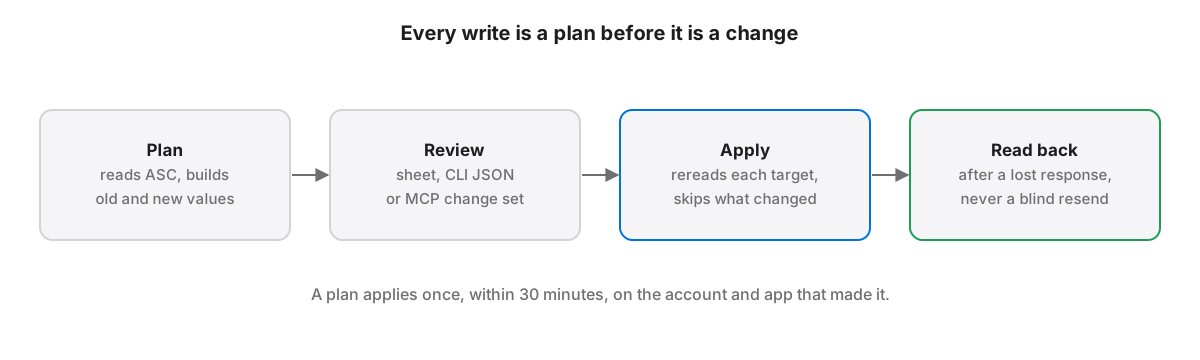
App Store Localization for Mac turns every write into a plan that lists each field's current value in App Store Connect and the value it will get. Apply reads every target again and skips any item that changed after planning, and a plan expires after 30 minutes.
A plan applies once, only on the account and app that produced it. If Apple's response to a write is lost, the app reads App Store Connect back to learn whether the write landed instead of sending it a second time. A price plan goes further: if any price changed after planning, Apply refuses the whole plan, because a partial price schedule can silently undo other territories.
The same plans come out of the asl command line and the MCP server, so a change proposed by Claude Code passes through the same review as one made by hand. The free download builds and shows every plan; only the Apply step needs a license.
What did the rewrite change in the pricing rule?
The Mac app's purchasing-power pricing leaves a territory at Apple's price when its price level is 0.60 or higher, never prices below 25% of Apple's automatic price, never above it, and always sends the complete schedule. The web app's pricing path had no gate, no floor and no anchor.
Price levels come from World Bank purchasing-power conversion factors divided by today's exchange rate, with the IMF used for Taiwan. Each target snaps to the nearest point on Apple's own price ladder. Venezuela, Yemen, Anguilla, Montserrat and the British Virgin Islands have no data and keep Apple's price.
The complete schedule matters most. Apple replaces an app's or an in-app purchase's schedule wholesale, so the web app's habit of sending only the territories it was changing could revert discounts set earlier. The details are in why App Store prices revert in some countries.
What does App Store Localization still not do?
App Store Localization for Mac does not research keywords, design screenshots, run Apple Search Ads or publish to Google Play. Creating a new app record and filling in the App Privacy declaration still happen on the App Store Connect website, because Apple's public API does not cover either one.
The app uploads screenshots you already have and checks their sizes before sending, but it does not make them. Keyword lists can be imported, and the translator works from your en-US keywords rather than inventing a strategy per market. Translation also needs Claude Code signed in, or an Anthropic or OpenAI API key; pricing, products, releases and reviews need only the App Store Connect key.
How do web app users switch to the Mac app?
Web app users download App Store Localization for Mac from appstorelocalization.com, add an App Store Connect API key with its Issuer ID, Key ID and .p8 file, and choose a role during onboarding. The free mode reads every app and plans every change; a $79 license turns on Apply.
The app is signed with Developer ID, notarized by Apple and updates itself; it is not on the Mac App Store. The license covers one Mac at a time and moves from Settings or the license page. It checks in every 7 days and keeps applying changes for 14 more days offline, so a trip without Wi-Fi does not lock a release.
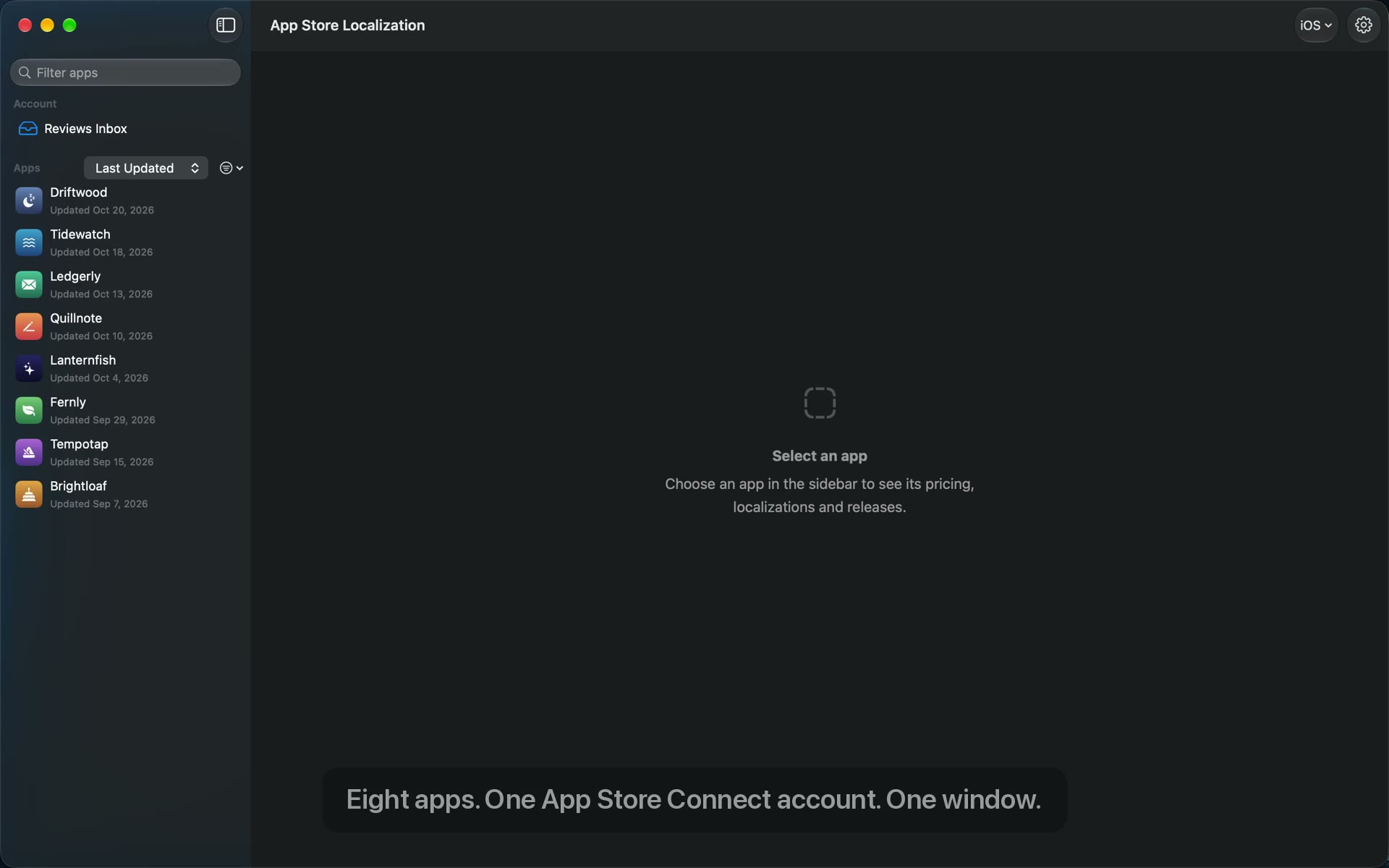
App Store Localization for Mac reads and plans every change for free; a one-time license applies them. macOS 26 or later.
Key takeaways
- App Store Localization is a Mac app since 2026-10-29; the hosted web app stays only for accounts already signed in.
- Your App Store Connect key stays in the macOS Keychain and every call goes from your Mac to Apple.
- Every write is a plan showing old and new values; Apply skips anything that changed since planning.
- Pricing now gates rich markets at 0.60, floors at 25% of Apple's price and always sends full schedules.
- Reading and planning are free; a one-time $79 license replaces the web app's $1 to $10 per action.
Frequently asked questions
Is the App Store Localization web app shutting down?
Yes, eventually. The hosted web app stays reachable for accounts that are already signed in while the Mac app proves itself in production, and it will be retired after that. New users get the Mac app from appstorelocalization.com. Nothing in your App Store Connect account depends on the web app, so moving over loses no data.
Does App Store Localization for Mac need a subscription?
No. App Store Localization for Mac is free to download and use for reading accounts and planning changes. A one-time $79 license, the launch price, applies plans from the app, the asl CLI and the MCP server on one Mac at a time. Translation uses your own Claude Code login or API key.
Which macOS version does App Store Localization require?
App Store Localization for Mac requires macOS 26 or later and an App Store Connect API key. It is distributed from appstorelocalization.com rather than the Mac App Store, signed with Developer ID, notarized by Apple, and it installs its own updates from inside the app when a new version ships.